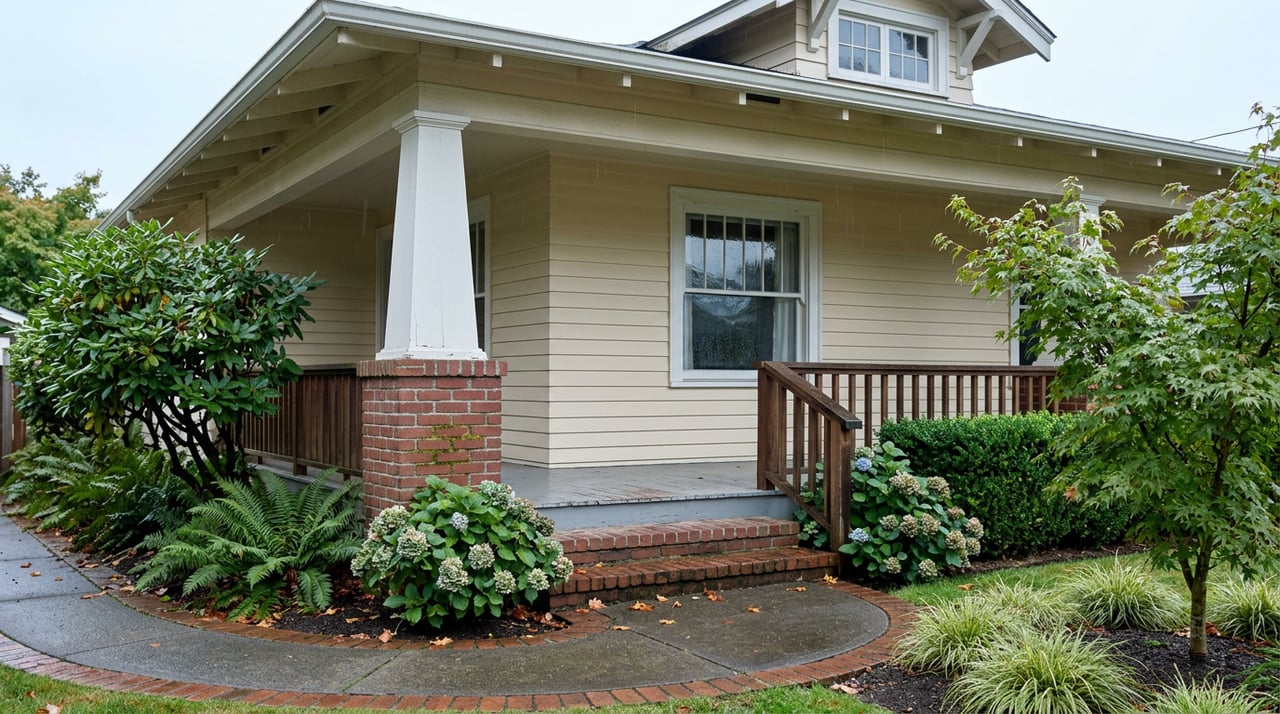
Ask someone who just closed on a Pearl District condo what their home costs every month, and the mortgage is only the first number they give you. The second number, the one that actually changes the math, comes from the HOA statement. Ask a Sellwood-Moreland buyer about their commute, and the answer depends entirely on whether they toured the house on a quiet Sunday afternoon or drove it during a Tuesday morning rush.
Portland's close-in neighborhoods get compared on one figure: the median sale price. Citywide, that number has settled in around $535,000 for the three months ending June 2026, a market that's competitive again but no longer frantic. That figure tells you almost nothing about what you're actually signing up for once the closing documents are filed. The differences between neighborhoods that look similarly priced on paper include factors beyond the sale price: HOA dues and whether a commute crosses a bridge.
Four Neighborhoods, One Deceptively Simple Chart
Buyers comparing Portland on price alone tend to pull up the same four close-in neighborhoods: Alberta Arts District, Hawthorne, Sellwood-Moreland, and the Pearl District. Recent listing data puts their price bands in a range that looks almost interchangeable at a glance.
| Neighborhood | Typical Price Band (2026) | Predominant Housing Stock |
|---|---|---|
| Alberta Arts District | roughly $450,000 to $600,000 | craftsman bungalows, cottages |
| Hawthorne | roughly $600,000 to $675,000 | bungalows, updated older homes |
| Sellwood-Moreland | roughly $630,000 | craftsman and early 20th-century homes |
| Pearl District | roughly $800,000 | condos, lofts, high-rise units |
Read across that table and the Pearl looks like the outlier on price, full stop. Read it again with carrying costs and commute patterns layered in, and the comparison gets more complicated. The Pearl's total cost of ownership includes more than its purchase price. And Sellwood-Moreland's mid-tier position on the chart says nothing about the one structural fact that governs daily life there.
HOA Costs Beyond the Purchase Price
Pearl District condos frequently look like the smarter buy on a price-per-square-foot basis when stacked against a single-family home in Hawthorne or Alberta. That comparison falls apart the moment you add the HOA statement. Newer Pearl buildings commonly run $500 to $900 a month in dues, and that number doesn't fluctuate with your mortgage rate or get any smaller if you refinance. Over a 30-year hold, that's a six-figure difference in carrying cost that never shows up in the sale price comparison.
This isn't a reason to avoid the Pearl. Plenty of buyers want the walkability, the galleries, and the building amenities enough to make the dues worth it. It's a reason to run the full cost of ownership, HOA included, before comparing a Pearl condo against a comparably priced craftsman a few miles east. The two purchases have different cost structures: the condo also has a monthly HOA payment.
The Bridge Is Doing More Work Than the Map Shows
Sellwood-Moreland markets itself on proximity: close to the river, close to downtown, close enough to feel connected without feeling urban. The proximity is real. For a commute across the river, a bridge crossing is still part of the equation.
The Sellwood Bridge is the city's southernmost span over the Willamette and the only river crossing for roughly 12 miles in either direction. Multnomah County's own data puts average daily traffic at 30,000 vehicles, making it the busiest two-lane bridge in the state. The county's FAQ on the bridge project is direct about what that means in practice: traffic congestion on the east side is a known problem during commute hours, one the Portland Bureau of Transportation has continued working on with the Sellwood neighborhood association since the current bridge opened in 2016.
Here's the detail that actually matters for a buyer running commute math: 83 percent of trips across the Sellwood Bridge begin or end outside Portland city limits. That's not a neighborhood bridge carrying local traffic. It's a regional bottleneck that happens to run through Sellwood-Moreland's front yard, and it means the 20-minute drive you clocked on a weekend showing can run closer to 40 minutes on a weekday morning. A house eight blocks from that bridge and a house eight blocks from a MAX Orange Line stop can carry the same asking price and deliver two completely different daily realities.
None of this makes Sellwood-Moreland a bad choice. The neighborhood's mix of craftsman and Victorian-era homes, its river access, and its slower residential pace are exactly what draws people there. It does mean the commute math deserves its own line of due diligence, separate from whatever the drive felt like on the day you toured the house.
Why Alberta and the Edges of Hawthorne Still Have Room to Run
If the Pearl's story is about HOA carrying costs and Sellwood's is about commute costs, Alberta Arts District and the eastern edges of Hawthorne tell a different kind of story: price appreciation that hasn't caught up yet.
Both neighborhoods sit meaningfully below Sellwood-Moreland and the Pearl on price, while offering comparable walkability, established housing stock, and their own commercial corridors. Alberta Street's continued draw as a walkable, mixed-use district and Hawthorne's ongoing pull for buyers who want a lively commercial strip within walking distance have kept demand steady even as citywide appreciation has cooled to roughly 3 percent over the past year, following a flat year before that. Neither neighborhood has priced in the same premium the Pearl commands for its urban core address, or that Sellwood-Moreland commands for its river-adjacent, family-friendly reputation.
That gap won't close on its own, and it won't close on any predictable schedule. What it does mean is that a buyer weighing Alberta or the Hawthorne edges against Sellwood-Moreland isn't just choosing a lifestyle. They're choosing between a neighborhood where the price has largely caught up to the demand, and two neighborhoods where it may not have yet.
How to Actually Compare These Neighborhoods
A median price comparison across these four neighborhoods will always look tidy and will always miss the parts that matter. Before treating any of them as interchangeable, it's worth running through a short list that the sale price alone won't answer:
- Pull the HOA budget and reserve study for any condo or townhome, not just the current monthly dues. Dues can and do increase.
- Time the actual commute during a weekday morning and evening, not just during a showing.
- Ask how many bridge or highway crossings the daily commute requires, and whether there's a second route if the first one backs up.
- Compare price per square foot only after adding recurring costs. HOA dues, not just property taxes, belong in that number.
- Look at how long comparable homes have sat on the market in each neighborhood over the past few months, not just the asking price.
A Few Direct Questions
Is Sellwood-Moreland a bad choice because of the bridge? Not at all. It's simply a neighborhood where the commute is more sensitive to timing than the map suggests. Buyers who work from home, work locally, or have flexible hours may never notice the difference. Buyers with a fixed downtown or Washington County commute should test the drive at the actual time they'd be making it.
Are Pearl District HOA fees negotiable? The dues themselves generally aren't, since they're set by the building's budget and reserve needs. What is worth negotiating, or at least investigating, is exactly what those dues cover and how the reserve fund is currently funded, since underfunded reserves can mean a special assessment down the road.
Is Alberta or Hawthorne a safer long-term bet than Sellwood-Moreland? Neither is inherently safer. They're different bets. Alberta and the Hawthorne edges carry more appreciation potential relative to their current price band. Sellwood-Moreland carries an established price and a well-understood tradeoff. The right one depends on what a buyer is optimizing for, not which neighborhood is objectively better.
The sale price is the easiest number to compare, which is exactly why it tells you the least. If you're weighing these neighborhoods against each other and want the carrying costs, commute realities, and pricing context run through for your specific situation, At Home With Kayla can walk through the comparison neighborhood by neighborhood. Request a home valuation to start the conversation, whether you're pricing a sale in one of these areas or figuring out what your budget actually buys across them.
This article is general information, not legal, tax or financial advice. Consult a qualified professional about your situation.